
Uganda's Future Depends on Institutions That Learn
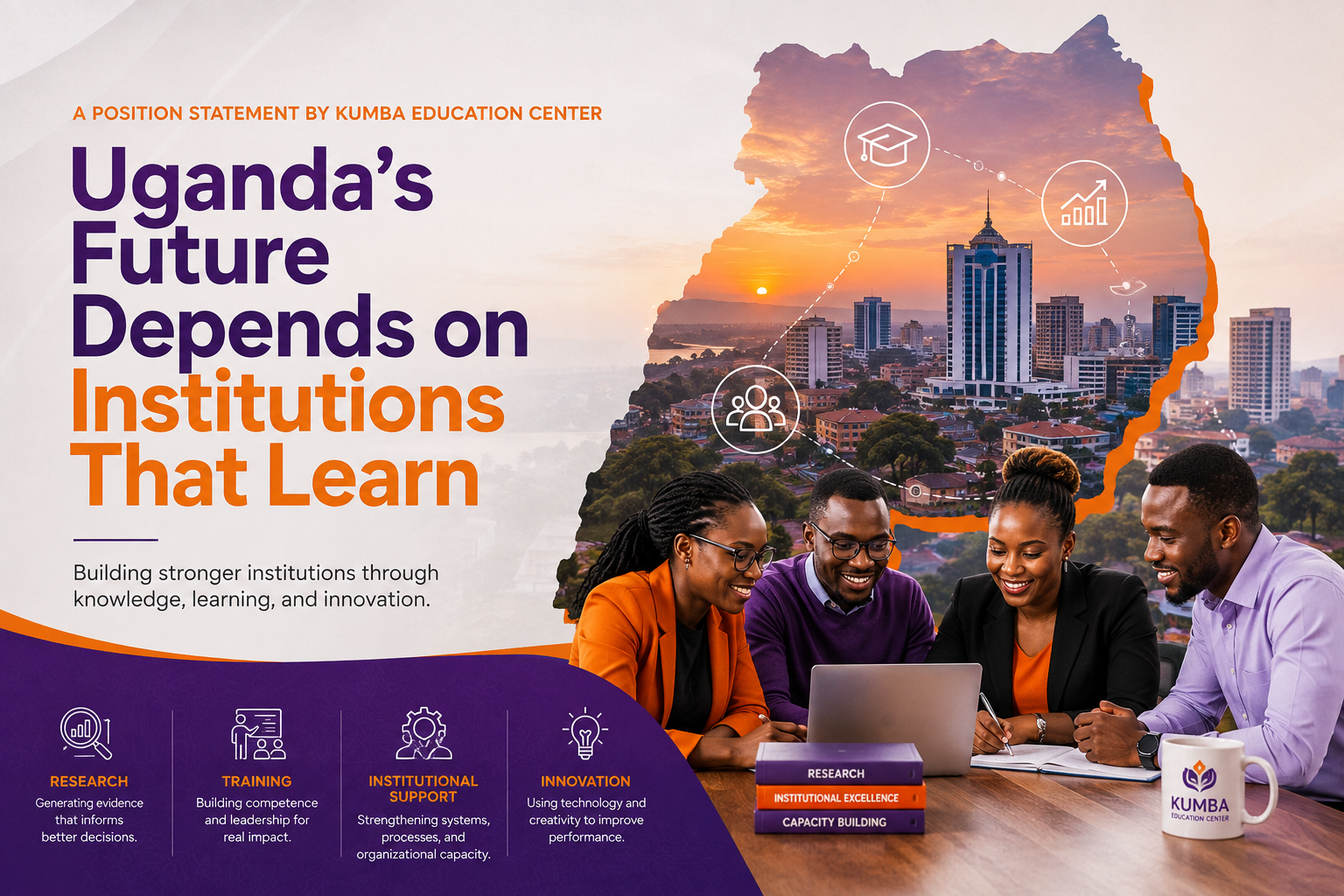
A Position Statement by Kumba Education Center
Uganda is a country of remarkable potential.
Our universities produce thousands of graduates every year. Our researchers continue to study important national challenges. Our entrepreneurs build businesses with limited resources. Our communities develop creative solutions to everyday problems.
Uganda does not lack intelligence.
Uganda does not lack ambition.
Uganda does not lack ideas.
The challenge is ensuring that these ideas, knowledge, and capabilities become part of strong institutions that can consistently deliver results.
At Kumba Education Center, we believe one of Uganda's greatest development opportunities lies in building institutions that can learn, adapt, and improve continuously.
Because sustainable progress does not come from individuals alone.
It comes from institutions that are designed to preserve knowledge, develop people, use evidence, and improve their systems over time.
The Gap Between Knowledge and Action
Uganda has invested significantly in education, research, technology, and development programmes.
However, the existence of knowledge does not automatically create transformation.
Research can be produced but never influence decisions.
Training can be delivered but fail to change organizational practice.
Technology can be introduced but simply digitize inefficient processes.
Policies can be developed but struggle during implementation.
The challenge is not only generating solutions.
The challenge is creating institutions capable of applying and sustaining them.
The World Bank has consistently emphasized that development outcomes depend heavily on institutional capacity — the ability of organizations to effectively use knowledge, resources, and systems to achieve their goals. Strong institutions are essential for translating investments into lasting results.
Uganda's Institutions Are Built on People. They Must Also Be Built on Systems.
Across Uganda, many organizations depend heavily on individual expertise.
A skilled manager leaves, and years of experience disappear.
A project coordinator moves on, and important knowledge is lost.
A researcher completes a study, but the findings never become part of institutional practice.
This creates a cycle where organizations repeatedly solve the same problems instead of building systems that prevent those problems from returning.
Strong institutions do something different.
They capture knowledge.
They develop people.
They create processes.
They use evidence.
They continuously improve.
This is the foundation of institutional learning.
Moving Beyond Short-Term Capacity Building
For many organizations, capacity building has traditionally meant workshops, seminars, and training sessions.
These activities have value, but lasting transformation requires more.
A certificate does not automatically create capability.
A report does not automatically create change.
A new software system does not automatically improve performance.
Real capacity building happens when learning becomes part of an organization's culture.
It happens when people are empowered to think critically, make better decisions, and improve the systems around them.
Kumba's Belief: Learning Institutions Build Stronger Uganda
At Kumba Education Center, we believe the institutions that will shape Uganda's future are those that develop the ability to learn.
A learning institution:
- uses evidence to guide decisions;
- invests in continuous improvement;
- develops its people;
- preserves organizational knowledge;
- adapts to new challenges;
- turns experience into better practice.
This belief guides our work across research, training, and institutional support.
Research That Informs Decisions
We believe research should not remain within academic spaces.
It should help organizations understand challenges, identify opportunities, and make better decisions.
Training That Creates Transformation
We believe learning should go beyond knowledge transfer.
Effective training should build confidence, competence, and the ability to apply knowledge in real situations.
Technology That Strengthens Institutions
We believe technology should support better systems, not simply replace manual processes.
The purpose of innovation is not technology itself.
The purpose is better outcomes.
A Stronger Uganda Requires Stronger Institutions
Uganda's future will not only depend on the resources we acquire.
It will depend on our ability to organize, learn, and improve.
The universities that create impact will be those that continuously evolve.
The businesses that survive will be those that build systems beyond individuals.
The organizations that serve communities effectively will be those that turn knowledge into action.
The government institutions that deliver better services will be those that learn from evidence and experience.
Progress becomes sustainable when institutions become stronger than the challenges they face.
Our Commitment
Kumba Education Center exists to contribute to the development of stronger Ugandan institutions.
We believe that research, learning, and innovation must work together to create organizations that are more capable, adaptable, and impactful.
Our goal is not simply to provide training or produce research.
Our goal is to help institutions build the capacity to continuously improve.
Because Uganda's transformation will not be built by ideas alone.
It will be built by institutions that know how to turn ideas into reality.
When institutions learn, Uganda grows.
Kumba Education Center
Building stronger institutions through knowledge, learning, and innovation.
Leave a comment
Comments are reviewed before they appear. Your email address is never published.